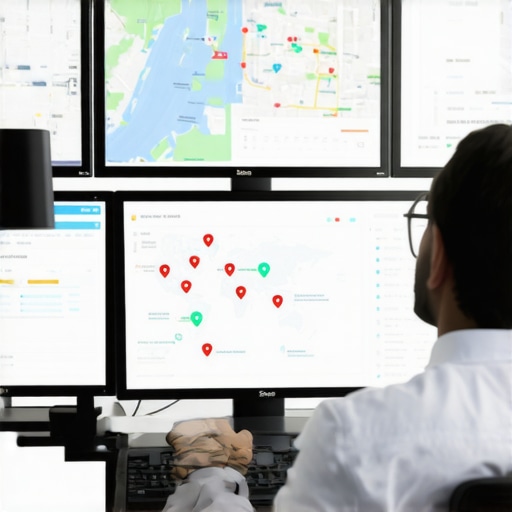
3 Audit Tools That Actually Help You Spy on Local Map Competitors
There is a specific kind of silence that haunts business owners in 2026. It’s the silence of a phone that isn’t ringing, despite the fact that your shop is open, your coffee is hot, and your service is impeccable. For many, this is the “Invisible Profile” crisis. You look for your business on Google Maps, and where you used to sit proudly in the top three, there is now a void – or worse, a competitor from three towns over who somehow jumped the queue.
As a Google Business Profile Product Expert, I’ve seen this scenario play out more frequently over the last year. The local search landscape has shifted. Proximity filters are now more aggressive than ever, and AI Answer Engines like Google Gemini are fundamentally changing how local stores are discovered. We are no longer just fighting an algorithm; we are fighting “ghost competitor profiles” that exploit gaps in local SEO to steal your traffic. If you aren’t actively monitoring what the guy down the street is doing, you aren’t just falling behind – you’re becoming invisible.
In this guide, I’m going to pull back the curtain on the three professional-grade audit tools I use to dismantle competitor strategies and reclaim Map Pack dominance. If you’ve ever wondered why your business profile vanished, you might find the answer in how your competitors are out-maneuvering you. For those already feeling the sting, check out our guide on Why Your Business Profile Vanished From Maps and the 4-Minute Recovery to start your comeback.
Why “Spying” is the Only Way to Rank in 2026
The days of “set it and forget it” for Google Business Profiles (GBP) are long gone. In 2026, ranking is a zero-sum game. For you to move up, someone else must move down. To facilitate that move, you need to understand the three pillars of local search: Proximity, Relevance, and Prominence. However, the weight of these pillars has shifted toward competitive intelligence.
Your competitors are likely already using advanced local seo tools to identify your weaknesses. They are looking at your category choices, your review velocity, and your “local signal stacking” to see where you’ve left the door open. If you want to rank google business profile listings effectively, you have to adopt the same “spy” mentality. You need to know exactly why Google thinks a competitor is more relevant to a user standing in the middle of your zip code than you are.
The aggressive proximity filters introduced recently mean that Google is tightening the radius of who it shows in the Map Pack. This means a competitor with better “Interaction Signals” – like more direction requests or longer dwell times on their profile – can actually beat you in your own backyard. You can’t fix what you can’t see. This is why you must Stop Map Ghosting: 5 Ranking Assistance Steps for 2026 and start using data-driven tools to fight back.
Tool #1: BrightLocal, The Comprehensive Audit Powerhouse
When I’m performing a deep-dive analysis for a client, BrightLocal is often my first stop. It isn’t just a reporting tool; it is a full-scale google business profile audit tool that allows you to benchmark your business against the top 10 competitors in your specific niche.
The Competitor Analysis Feature
BrightLocal’s Local Search Audit tool is a goldmine for competitive intelligence. It doesn’t just tell you that you’re in 4th place; it breaks down the “why.” It compares your profile side-by-side with your competitors across several key metrics:
- Review Count and Rating: Are they out-pacing you in fresh reviews?
- NAP Consistency: Do they have a cleaner digital footprint (Name, Address, Phone) than you?
- On-Site SEO: How well is their linked website optimized for local keywords compared to yours?
- Google Business Profile Completeness: Are they using features like “Products” or “Q&A” that you’ve ignored?
Tracking Citations and Authority
One of the biggest mistakes I see businesses make is neglecting their citation profile. BrightLocal allows you to spy on where your competitors are listed. If they have a link from a high-authority local chamber of commerce or a niche-specific directory that you don’t, they have an authority advantage. By identifying these gaps, you can systematically close them. I often tell my clients to look at How to Use a Profile Audit Tool to Spot Invisible Errors Killing Your Rank to understand how these small technical discrepancies add up to a major ranking loss.
In the 2026 landscape, BrightLocal has also integrated AI-driven insights that predict which citations will move the needle most for your specific industry. It’s no longer about quantity; it’s about the relevance of the local signal.
Tool #2: Local Falcon, Visualizing the Proximity Battle
If BrightLocal is the broad-spectrum microscope, Local Falcon is the heat-seeking radar. In the world of google business profile seo, ranking #1 at your office address means nothing if you drop to #10 two blocks away. This is the “Proximity Filter” in action, and Local Falcon is the best way to see it.
The Power of the Geo-Grid
Local Falcon is a premier google maps rank tracker because it uses a visual grid system. You choose a keyword – say, “Emergency Plumber” – and a grid size (e.g., 7×7 points over a 5-mile radius). The tool then checks your ranking at every single one of those points.
When you run this for a competitor, you can see exactly where their “influence” ends. Does their ranking drop off sharply to the North? That’s where you should focus your local content and geotagged image efforts. By visualizing the “Ranking Heatmap,” you can identify “blind spots” in the market. If no one is dominant in the Southeast corner of your city, that is your primary target for expansion.
Beating the Proximity Filter
The 2026 algorithm prioritizes “Behavioral Signals” within specific geographic pockets. If Local Falcon shows a competitor is dominating a high-traffic area, it’s likely because they are getting more direction requests from that specific zone. To counter this, I recommend using The Ultimate Google Maps SEO Audit Checklist for 2026 to ensure your profile is optimized to trigger those essential interaction signals. Local Falcon’s “Trend Reports” also allow you to see if a competitor’s recent push (like a new ad campaign or a flurry of reviews) is actually expanding their map territory in real-time.
Tool #3: GMB Everywhere, The Category & Signal Specialist
Sometimes the most powerful “spy” tools are the ones that sit right in your browser. GMB Everywhere is a Chrome extension that provides instant, high-level data on any business you find on Google Maps. It is one of the most essential gmb seo tools for real-time competitive research.
Extracting Category Secrets
One of the most common reasons a business fails to rank is “Category Mismatch.” Google allows one primary category and up to nine secondary categories. Most business owners only see the primary category on a public profile. GMB Everywhere breaks this wide open. It shows you exactly which secondary categories your top-ranking competitors are using.
For example, if you are a “Lawyer” but your competitor is ranking for “Personal Injury Attorney” as their primary and “Trial Attorney” as a secondary, they are capturing a much wider net of search intent. Finding these “hidden” categories is often the quickest way to improve google maps ranking results without spending a dime on ads.
Review Velocity and Posting Frequency
GMB Everywhere also provides a “Review Audit” and a “Post Audit.” You can see how often a competitor is posting updates to their profile and what their average review growth rate is. In 2026, Google rewards “Active Profiles.” If your competitor is posting three times a week and you haven’t posted since 2024, Google views them as more relevant to the current user. To stay competitive, you need to understand the 7 Authority Signals for GMB Ranking Success in 2026 Results, which include these critical activity metrics.
By using GMB Everywhere, you can also see the “Teleport” feature, which allows you to see what the search results look like from a different geographic coordinate without actually being there. This is vital for checking if your “spy” data matches the reality of a user on the ground.
Advanced Strategy: Beyond the Tools
While tools provide the data, your strategy provides the win. In my experience as a consultant, the businesses that dominate the Map Pack in 2026 are those that go beyond basic tool outputs and engage in “Local Signal Stacking.”
Geotagging and Local Context
One expert-level move is to analyze the images your competitors are uploading. Are they high-quality, original photos, or stock images? Google’s AI (Gemini) can now “read” the contents of an image. If your competitor is uploading photos of their team working at recognizable local landmarks, they are sending a massive “Relevance” signal to Google. You should counter this by ensuring your images are not only geotagged but also contextually relevant to your service area.
Preparing for AI Search (SGE)
We are moving into a world where Google’s Search Generative Experience (SGE) will summarize local options for users. To be the business that the AI recommends, your profile needs to be cited in AI-generated local answers. This happens when your business is mentioned in local news, blogs, and high-authority directories. This is what we call “Prominence.” If you aren’t stacking these signals, you are leaving your ranking to chance.
I always advise my clients that neglecting local signal stacking creates gaps that savvy competitors will exploit. You need to be proactive. If you feel overwhelmed by the technical requirements, seeking a professional google maps ranking service can bridge the gap between having the data and actually moving the needle.
Conclusion & Action Plan
The “Invisible Profile” crisis is real, but it is also avoidable. By using BrightLocal for deep audits, Local Falcon for proximity visualization, and GMB Everywhere for category and activity spying, you can build a roadmap to the top of the Map Pack.
Ranking in 2026 requires a blend of technical precision and competitive aggression. Don’t wait for your leads to dry up before you take action. Perform a competitor audit today. Identify one category you’re missing, one local signal you haven’t stacked, or one geographic “blind spot” you can claim.
If you’re ready to stop guessing and start winning, it might be time to bring in the experts. Whether you need a comprehensive audit or a full-scale google maps ranking service, the goal remains the same: dominance. Your competitors are watching you – it’s time you start watching them back.